


Fake PayPal Account Review Emails Are Reaching Your Staff
PayPal-spoofed phishing emails target staff with fake account review alerts to harvest credentials via fraudulent login pages.
A phishing campaign impersonating PayPal is designed to harvest your account credentials by convincing your staff to click through and "confirm" personal and financial details. If acted upon, the consequences extend beyond a compromised PayPal account — reused passwords, linked payment methods, and stored financial data all become accessible to the threat actor, exposing your organisation to fraud and potential downstream compromise of other services.
This campaign has been observed across multiple local organisations, with a cluster of messages appearing in NZ inboxes over a short window spanning several days. The cross-organisational spread suggests an automated distribution effort rather than a targeted attack, meaning your staff are likely to encounter this regardless of industry or size.
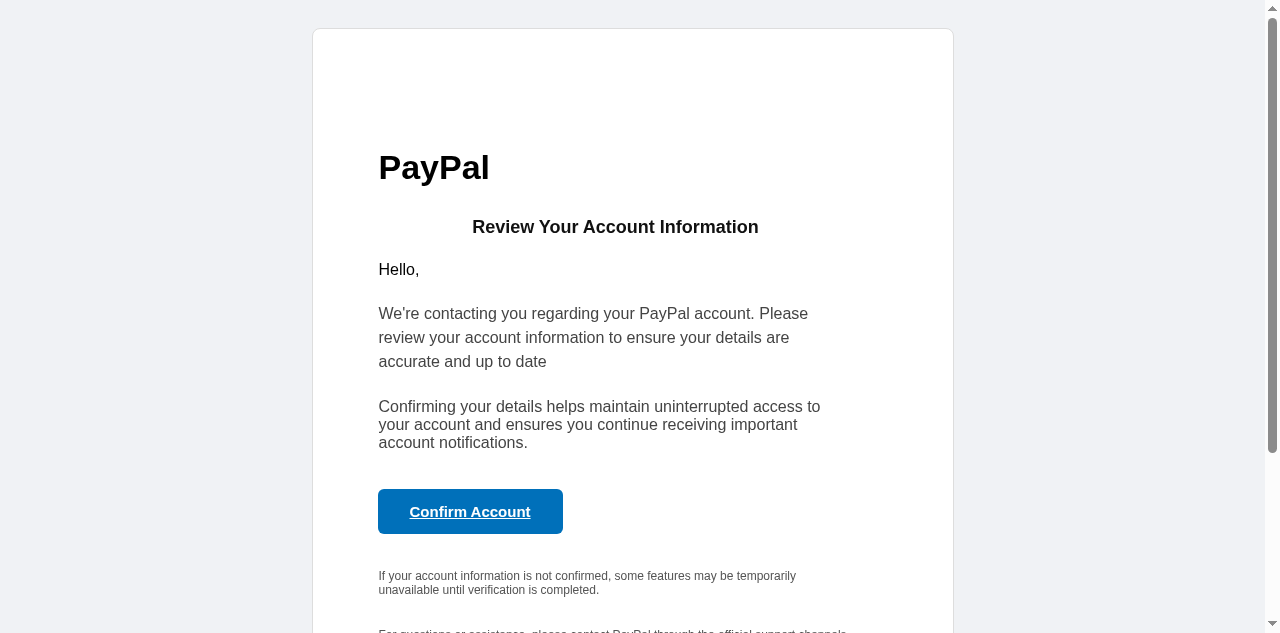
The email presents a convincing PayPal template — familiar branding, a measured tone, and a plausible pretext around keeping account details current. However, the sending domain has no affiliation with PayPal whatsoever, originating from a French-registered domain with no legitimate connection to the brand. Despite a passing DKIM result, both SPF and DMARC checks fail, indicating the message was not authorised by PayPal's mail infrastructure and should not have passed as legitimate correspondence.
What makes this campaign particularly worth noting is the combination of a soft-failing SPF result alongside a DKIM pass — a configuration that can cause some filtering systems to treat the message more leniently than a hard fail would warrant. This mixed authentication profile is increasingly used by threat actors to slip past automated defences while still failing the composite authentication check that matters most. The email body also trails off mid-sentence in its feature-restriction warning, suggesting a templated payload that may be part of a broader, evolving kit being reused across multiple campaigns.
The domain the message claims to be from. Fresh registrations and known-bad reputations are the strongest technical tells of a spoofed sender.
Where a reply to this message would actually be delivered. When it differs from the visible From address, an unsuspecting reply lands with the attacker instead.
Practical steps you or your IT provider can take to reduce the risk from this kind of threat.
- Delete the email immediately without clicking any links or downloading attachments, as the sender domain "avvv.fr" is a French domain with no legitimate connection to PayPal.
- Report the phishing email to CERT NZ at certanz.govt.nz and forward it to PayPal's official phishing address (phishing@paypal.com) to help protect other Kiwi businesses.
- Verify your PayPal account status by navigating directly to paypal.com in your browser — never through links in unsolicited emails — to confirm whether any genuine account action is required.
- Alert your staff and colleagues about this specific campaign, sharing the sender address "info@avvv.fr" and subject line "Review Your Account Information" so they can recognise and avoid it.
- Enable multi-factor authentication (MFA) on your PayPal account and any other business financial platforms to reduce the risk of unauthorised access if login credentials have been compromised.

See what a genuine PayPal message looks like, the real sender domain, the real link destination, and where to report a fake.
The Local Vocal is published by Decision1 IT Solutions. If one of these landed in your inbox, or someone in the team clicked, give us a call.